

Neptune
- STEM CLUB
- Nov 5, 2020
- 2 min read

“The discovery in 1846 of the planet Neptune was a dramatic and spectacular achievement of mathematical astronomy. The very existence of this new member of the solar system, and its exact location, were demonstrated with pencil and paper; there was left to observers only the routine task of pointing their telescopes at the spot the mathematicians had marked.”
— James Roy Newman
Neptune, also known as the Blue Planet, is the eight planet in our solar system, and is the planet furthest from the Sun. Let’s take a closer look at our neighbor planet that is nearly 3 billion miles away from planet Earth!
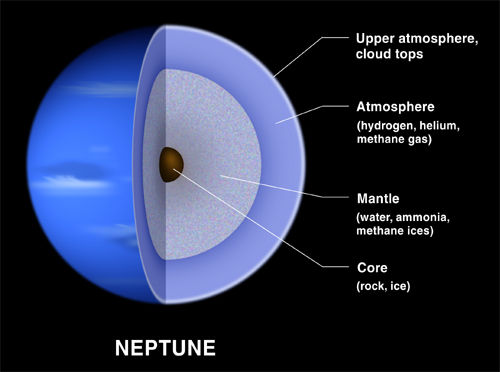
Compared to Earth, Neptune can definitely be considered a giant- weighing 17 times more and measuring 4 times wider than Earth- Neptune is the fourth largest planet. Neptune is an ice giant, with water, methane, and ammonia making up the majority of its mass. Neptune’s atmosphere is made up of molecular hydrogen, atomic helium and methane.
It takes Neptune 165 years in order to make one orbit around the sun. Since its discovery in 1846, Neptune completed its first revolution in 2011. However, one rotation for Neptune, or one day on Neptune, takes only 16 hours compared to the 24 hours it takes for Earth to complete one rotation.
Because of the distance between Earth and Neptune, only one spacecraft, Voyager 2, has been able to study Neptune closely. From this research, we know that Neptune has 14 moons, all named after Greek gods and nymphs, and 7 rings, made of dust and debris.
Neptune was the first planet that was discovered through mathematics, after scientists noticed a strange gravitational pull that was disturbing Uranus’ orbit. Though as of now, scientists have concluded that Neptune cannot support life, hopefully in the future, humans will be able to get a closer look at this stunning ice giant.


Comments